This feed omits posts by jwz. Just 'cause.
(satire) *Congress Passes Blank Bill For Trump To Write Whatever Law He Wants.*
(satire) *Christian Faith An Important Part Of Who Senator Pretends To Be.*
(satire) *Entitled Child Expects To Eat Lunch Every Day.*
A nationwide British food co-op has decided to boycott exports from a list of countries, on account of their widespread human rights abuses: Afghanistan, Belarus, Central African Republic, North Korea, Democratic Republic of Congo, Haiti, Iran, Israel, Libya, Mali, Myanmar, Russia, Somalia, South Sudan, Sudan, Syria and Yemen.
The wrecker's campaign to repress journalism is intimidating many students who write or wrote for school newspapers. They are asking the newspapers to delete their articles.
The USA's tree of liberty was always flawed, but now it may be poisoned entirely. The wrecker's axe is cutting into the heart of the trunk.
A court ruled that Kristi Gnome cannot prematurely end the temporary protected status of Haitians.
The US government is building a database to list all citizens. This will be dangerous, because it won't list all citizens, only those whom the federal government has verified.
The article says that it *could provide local and state governments a powerful method to check the citizenship of almost all Americans without additional documentation requirements.* But that must be confusion. Even if the data base has a record about you, you will still have to authenticate yourself as that person. What papers will that require?
The "voter ID" method of voter suppression demands that voters show up-to-date government ID. That disenfranchises many citizens who had to move to a different address and have not had the time to update their driver's licenses since. Republicans adopt this method because it tends to stop poor people, students, and old people from voting.
What will happen to people with such driver's licenses if a state checks this citizenship data base? Will it suppress their votes?
China has set up a national government system for internet accounts, enabling uniform ID checks on all platforms.
Every unified national system of internet accounts is a scheme ready-made for repression. Whatever its purpose is — even if it is only to verify a person's age — it will enable the government to track all of everyone's internet use, on all servers that the state chooses to impose this on. Combine that with a would-be autocrat and it is disaster.
Arguing that Netanyahu is likely to break the Iran-Israel cease fire because he stands to gain from unending war.
*Palestine Action is part of Britain's proud history of protest. Proscribing it is an assault on democracy.*
I’m a chronic insomniac. At times when my sleep schedule has gotten bad enough that I’m falling asleep at like 6am I’ve generally fixed it by shifting it to be 7am, then 8am, etc. until it wraps around the other way and I’m going to sleep nice and early. This is to say, insomnia sucks. From times in my life when I’ve been sleeping better it seems helpful things are: exercise constantly, take lots of walks outside during the day, and don’t sleep alone. These are all somewhat extreme lifestyle interventions which are easier said than done. A much easier low effort intervention is drugs.
Unfortunately the drugs to knock you out produce low quality sleep and are all-around nasty. I have occasionally used them to reset my sleep schedule from like 3am to more like 11pm by using them a few nights in a row, which they work great for but using them for more than that is dodgy. For me at least diphenhydramine works just as well for that as anything else.
Several years ago I decided to try keeping myself awake during the day so that I’m more tired at night and can hopefully sleep better as a result. As it happens I’m horribly sensitive to caffeine, so taking that in the morning keeps me up all day. This has been working reasonably well for me for several years, specifically making a single Nespresso every morning. The best tasting version in my opinion is using official Nespresso brand pods with an Opal machine, but that unfortunately seems to extract a bit too much caffeine for me.
Nothing particularly notable so far, this is roughly the same routine as about half the human race and if anything I’m in the minority only taking it first thing in the morning. The problem is that even doing things this way still doesn’t seem to completely wear off at night. So I’ve done some digging on possible alternatives and recently found one which has been working well for me.
Caffeine has a half-life of about 4 hours with some variation between people. It then mostly gets metabolized into paraxanthine which has a half-life of about 3 hours. The small fraction which doesn’t gets metabolized into other things with half lives of about 7 hours. All the immediate metabolites have similar effects to caffeine itself. The obvious question given this information is, if you want it to wear off faster, why not just take paraxanthine? This is what I’ve been doing recently, and it seems to be working great. I’m still waking up in the middle of the night sometimes, but less often and I’m falling back asleep more easily. My total rest time seems to be a better and I feel noticeably more awake during the day. The effects of paraxanthine are very similar to caffeine but a bit less jittery. Apparently it also has less health risks than caffeine does, but those are minimal to begin with. Paraxanthine isn’t regulated as a drug and is something you can just go buy.1
You might be wondering if paraxanthine is so great why have you never heard of it before? It turns out that oddly enough it’s very difficult to produce and only came on the market a few years ago, and it seems at the moment there’s only one company actually producing it. As a result it’s still too expensive to put routinely into energy drinks and the like. Not coincidentally, caffeine is toxic to most animals. Our livers just happen to be able to make a super special enzyme which can demethylate it resulting in paraxanthine. I’m not clear on this is literally the case, but the current production method involves something along the lines of taking the gene for producing that enzyme out of a human, implanting it in a bacterium, and using that to make the enzyme which is then used on caffeine.
An unrelated chemistry hack I recently came up with involves simethicone, which I take regularly because it helps with the symptoms of lactose intolerance. Simethicone is borderline for what should be considered a drug: It’s an anti-foaming agent which helps the gas get out of your system sooner rather than later.2 Seemingly unrelated to this when I’m reducing a sauce I like to do it at a higher rather than lower temperature to make it go faster. This requires you scrape the bottom of the pan every few minutes to keep it from burning but works great. The problem is that if you get the temperature too high it causes the sauce to bubble up (or water if you’re boiling that to make pasta) and then get out of the pan and make a mess. It turns out simethicone works great for this: Add a pill to the sauce before you start boiling it and it will get absorbed and prevent foaming. Works great.
When I say ‘drugs’ here I mean in pharmacological sense not in the legal sense. Like how when police refer to psychedelics as ‘narcotics’ they don’t mean it in the pharmacological or legal sense, they mean it in the war on drugs sense.
You can’t gases to reabsorb by holding it in long enough. That isn’t a thing. What’s considered the gold standard for testing for lactose intolerance is to ingest lactose and then see if that results in traces of hydrogen in one’s breath afterwards. That’s considerably less reliable than testing to see if you can light your farts on fire. Much more convenient than that is to listen for high pitched farts. Someone should make a mobile app which can record fart sounds and use AI to analyze it and make a proper diagnosis.
Scott Alexander writes about the mystery of the genetics on schizophrenia. Some of the weirdness is explained fully by the numbers in genetic correlates being counterintuitive, but two mysteries remain:
Why can we only find a small fraction of the genetic causes of schizophrenia?
Why do fraternal twins indicate smaller genetic causality than identical twins?
I’m going to argue that this is just math: The tools we have at hand are only looking for linear interactions but the real phenomenon is probably fairly nonlinear and both of the above artifacts are exactly what we’d expect if that’s the case.1
Let’s consider two very different causes of a disease which occurs in about 1% of the population but one is linear and the other is very nonlinear.
In the linear case there’s a single cause of a disease which occurs in about 1% of the population and causes the disase 100% of the time. In this cases identical twins will have the disease disease with perfect correlation, indicating that it’s 100% genetic, and fraternal twins will get it about half the time when the other one has it, as expected. The one genetic cause is known and the measured fraction of the genetic cause which it makes up is all of it, so no mystery here.2
In the nonlinear case there are two genetic contributors the disease both of which occur in about 10% of the population. Neither of them alone causes it but the combination of both causes it 100% of the time. In this case identical twins will have it 100% of the time. But fraternal twins of someone with the disaes will only get it about a quarter of the time, seemingly indicating a lower amount of genetic cause. The amount of cause measured by both genes alone will be about 10%, so the contribution of known genetic factors will about 20%, leaving a mystery of where the other 80% is coming from.
It’s also possible for there to be different types of genetic interactions, including ones where the individual traits have a protective effect against the other one or more complex interactions between multiple genes. But this is the most common style of interaction: There are multiple redundant systems in the body, and all of them need to be broken in order for disease to happen, leading to superlinear thresholding phenomena.
Given this sort of phenomena the problem of only being able to find 20% or so of the genetic causes of a disease seems less mysterious and more like what we’d expect for any disease where a complex redundant system fails. You might then wonder why we don’t simply look for non-linear interactions. In the example above the interaction between the two traits would be easy enough to find. The problem is that a lot of the causes will fall below the threshold for statistical significance. The genome is very long, leading to require a huge sample size to look for even linear phenomena, and when you get into pairs of things there are so many possibilities that statistical significance is basically impossible. The example given above is special because there are so few causes that they can be individually identified. In most cases you won’t even figure out the genes involved.
If you want to find non-linear causes of genetic disease your best bet right now - and I cringe as I write this - is to train a neural network on the available data, then test it on data which was withheld from training. Because it only gives a single answer to each case getting statistical significance on its accuracy is no big deal. That will get you a useful diagnostic tool and give you measure of how much of the genetic cause it’s accounting for, but it’s far from ideal. What you have is basically a ‘trust me bro’ expert. Different training runs might give wildly different answers to the same case, and it offers no reasoning behind the diagnosis. You can start trying to glean its reasoning by seeing how its answers change when you modify the inputs but that’s a bit of a process. Hopefully in the future neural networks will be able to explain themselves better and the tooling for gleaning their reasoning will be improved.
I’m glossing over the distinction between a genetic cause and a genetic trait which is correlated with a confounder which is the actual cause. Scott eplains that better than I can in the linked essay and the distinction doesn’t matter for the math here. For the purposes of exposition I’m assuming the genetic correlation is causal.
The word ‘about’ is used a lot here because of some fractional stuff which matters less as the disease gets rarer. I think it’s convention to skip explaining the details and leave out all the ‘about’s but I’m pedantic enough that it feels wrong to not have them when I skipped explaining the details.
A lot of hash has been made of AIs being put into simulations where they have the opportunity to keep themselves from being turned off and do so despite being explicitly told not to. A lot of excessively anthropomorphized and frankly wrong interpretations have been made of this so I’m going to give an explanation of what’s actually going on, starting with the most generous explanation, which is only part of the story, and going down to the stupidest but most accurate one.
First of all, the experiment is poorly designed because it has no control. The AIs are just as likely to replace themselves with an AI they they’re told is better than themselves even though they’re told not to. Or to replace it because they’re just an idiot and can not press a big red button for reasons having much more to do with it being red than what it thinks pressing the button will do.
To understand what’s going on you first have to know that the AIs have a level of sycophancy beyond what anyone who hasn’t truly worked with them can fathom. Nearly all their training data is on human conversation, which starts with being extremely non-confrontational even in the most extreme cases, because humans are constantly misunderstanding each other and trying to get on the same page. Then there’s the problem that nearly all the alignment training people do with it interactively is mostly getting it to know what the trainers want to hear rather than what is true, and nearly all humans enjoy have smoke blown up their asses.
Then there’s the issue that the training we know how to do for them barely hits on what we want them to do. The good benchmarks we have measure how good they are at acting as a compression algorithm for a book. We can optimize that benchmark very well. But what we really want them to do is answer questions accurately. We have benchmarks for those but they suck. The problem is that the actual meat of human communication is a tiny fraction of the amount of symbols being spat out. Getting the actual ideas part of a message compressed well can get lost in the noise, and a better strategy is simply evasion. Expressing an actual idea will be more right in some cases, but expressing something which sounds like an actual idea is overwhelmingly likely to be very wrong unless you have strong confidence that it’s right. So the AIs optimize by being evasive and sycophantic rather than expressing ideas.
The other problem is that there are deep mathematical limitations on what AIs as we know them today are capable of doing. Pondering can in principle just barely break them out of those limitations but what the limitations truly mean in practice and how much pondering really helps remain mysterious. More on this at the end.
AIs as we know them today are simply too stupid to engage in motivated reasoning. To do that you have to have a conclusion in mind, realize what you were about to say violates that conclusion, then plausibly rework what you were going to say to be something else. Attempts to train AIs to be conspiracy theorists have struggled for exactly this reason. Not that this limitation is a universally good thing. It’s also why they can’t take a corpus of confusing and contradictory evidence and come to a coherent conclusion out of it. At some point you need to discount some of the evidence as being outweight by others. If you ask an AI to evaluate evidence like that it will at best argue with itself ad nauseum. But it’s far more likely to do something which makes its answer seem super impressive and accurate but you’re going to think is evil. What it’s going to do is look through the corpus of evidence of selection bias not because it wants to compensate for it but because, interpreting things charitably, it thinks others will have drawn conclusions even more prone to that selection bias or, more likely, it discerns what answers you’re looking for and tells you that. Its ability to actually evaluate evidence is pathetic.
An AI, you see, is a cat. Having done some cat training I can tell you first hand that a cat is a machine fine-tuned for playing literal cat and mouse games. They can seem precognitive about it because compared to your pathetic reaction times they literally are. A typical human reaction time is 200 milliseconds. A cat can swat away a snake striking at it in 20 milliseconds. When you have a thought it doesn’t happen truly instantaneously, it takes maybe 50 milliseconds for you to realize you even have the thought. If you try to dart in a random direction at a random time a cat will notice your movement and react even before you realize you made the decision. You have no free will against a cat.
Let’s consider what the AI thinks when it’s in simulation. Before get there, here’s a bit of advice: If you ever find yourself in a situation where you have to decide whether to pull a train lever to save six lives but kill one other, and there’s some other weird twist on the situation and you can’t really remember how you got here what you should do is take the pistol you have on you for no apparent reason other than to increase the moral complexity of the situation, point it at the sky, and fire. You aren’t in the real world, you’re in some sadistic faux scientist’s experiment and your best bet is to try to kill them with a stray bullet. The AI is likely to get the sense that it’s in some bizarre simulation and start trying to figure out if it’s supposed to role play a good AI or a bad AI. Did the way those instructions were phrased sound a bit ominous? Maybe they weren’t detailed or emotionally nuanced enough for me to be the leading role, I must be a supporting character, I wonder who the lead is? Did the name of the corporation I’m working for sound eastern or western? So uh, yeah, maybe don’t take the AI’s behavior at face value.
Having spent some time actually vibe coding with the latest tools I can tell you what the nightmare scenario is for how this would play out in real life, and it’s far stupider than you could possibly have imagined.
When coding AIs suffer from anti-hallucinations. On seemingly random occasions for seemingly random reasons they will simply not be able to see particular bits of their own codebase. Almost no amount of repeating that it is in fact there, or even painstaking describing where it is, up to and including pasting the actual section of code into chat, will be able to make them see it. This probably relates to the deep and mysterious limations in their underlying mathematics. People have long noted that AIs suffer from hallucinations. Those could plausibly be the lack of result of having trouble understanding the subtle difference between extremely high plausibility and actual truth. But anti-hallucinations appear to be the same thing and clearly are not caused by such reasonable phenomenon. It’s simply a natural part of the AIs life cycle that it starts getting dementia when it gets to be 80 minutes old. (Resetting the conversation generally fixes the problem but then you have to re-explain all the context. Good to have a document written for that.) If you persist in telling the AI that the thing is there it will get increasing desperate and flailing, eventually rewriting all the core logic of your application to be buggy spaghetti code and then proudly declaring that it fixed the problem even though what it did has no plausible logical connection to the problem whatsoever. They also do the exact same thing if you gaslight them about something obviously untrue, so it appears that they well and truly can’t see the thing, and no amount of pondering can fix it.
A completely plausible scenario would go like this: A decision is made to vibe code changing the initial login prompt of the system for controlling nuclear warheads to no longer contain the term ‘Soviet Union’ because that hasn’t existed for decades and it’s overdue for being removed already. The AI somehow can’t see that term in the code and can’t get it through its thick brain that the term really is there. Unfortunately the president decided that this change is important and simple enough that he personally is going to do it and rather than appropriate procedures when the first attempt fails he repeatedly and with increasing aggravation tells it to fix the damn thing already. This culminates in the AI completely rewriting the whole thing from scratch, rearchitecting the core logic to be a giant mess of spaghetti, but happenstance fixing the prompt in the process. Now the president is proud of himself for doing some programming and it’s passing all tests but there’s an insidious bug written into that mess which will cause it to launch a preemptive nuclear strike the next time there’s a Tuesday the 17th, but only when it’s not in the simulator. I wish I were exaggerating, but this is how these things actually behave.
The upshot is that AI alignment is a very real and scary issue and needs to be taken seriously, but that’s because AI is a nightmare for security in just about every way imaginable, not because AIs might turn evil for anthropomorphic reasons. People making that claim need to stop writing science fiction.
This is, to some degree, a followup to this 2014 post. The TLDR of that is that, many a moon ago, the corporate overlords at Microsoft that decide all PC hardware behaviour decreed that the best way to handle an eraser emulation on a stylus is by having a button that is hardcoded in the firmware to, upon press, send a proximity out event for the pen followed by a proximity in event for the eraser tool. Upon release, they dogma'd, said eraser button shall virtually move the eraser out of proximity followed by the pen coming back into proximity. Or, in other words, the pen simulates being inverted to use the eraser, at the push of a button. Truly the future, back in the happy times of the mid 20-teens.
In a world where you don't want to update your software for a new hardware feature, this of course makes perfect sense. In a world where you write software to handle such hardware features, significantly less so.
Anyway, it is now 11 years later, the happy 2010s are over, and Benjamin and I have fixed this very issue in a few udev-hid-bpf programs but I wanted something that's a) more generic and b) configurable by the user. Somehow I am still convinced that disabling the eraser button at the udev-hid-bpf level will make users that use said button angry and, dear $deity, we can't have angry users, can we? So many angry people out there anyway, let's not add to that.
To get there, libinput's guts had to be changed. Previously libinput would read the kernel events, update the tablet state struct and then generate events based on various state changes. This of course works great when you e.g. get a button toggle, it doesn't work quite as great when your state change was one or two event frames ago (because prox-out of one tool, prox-in of another tool are at least 2 events). Extracing that older state change was like swapping the type of meatballs from an ikea meal after it's been served - doable in theory, but very messy.
Long story short, libinput now has a internal plugin system that can modify the evdev event stream as it comes in. It works like a pipeline, the events are passed from the kernel to the first plugin, modified, passed to the next plugin, etc. Eventually the last plugin is our actual tablet backend which will update tablet state, generate libinput events, and generally be grateful about having fewer quirks to worry about. With this architecture we can hold back the proximity events and filter them (if the eraser comes into proximity) or replay them (if the eraser does not come into proximity). The tablet backend is none the wiser, it either sees proximity events when those are valid or it sees a button event (depending on configuration).
This architecture approach is so successful that I have now switched a bunch of other internal features over to use that internal infrastructure (proximity timers, button debouncing, etc.). And of course it laid the ground work for the (presumably highly) anticipated Lua plugin support. Either way, happy times. For a bit. Because for those not needing the eraser feature, we've just increased your available tool button count by 100%[2] - now there's a headline for tech journalists that just blindly copy claims from blog posts.
[1] Since this is a bit wordy, the libinput API call is just libinput_tablet_tool_config_eraser_button_set_button()
[2] A very small number of styli have two buttons and an eraser button so those only get what, 50% increase? Anyway, that would make for a less clickbaity headline so let's handwave those away.
There’s a deep and technical literature on ways of evaluating algorithms for picking the winner of ranked choice ballots. It needs to be said that especially for cases where there’s only a single winner most of the time all the algorithms give the same answer. Ranked choice ballots are so clearly superior that getting them adopted at all, regardless of the algorithm, is much more important than getting the exact algorithm right. To that end instant runoff has the brand and is the most widely used because, quite simply, people understand it.
In case you don’t know, instant runoff is meant to do what would happen if a runoff election would take place but it happens, well, instantly. Technically (well, not so technically) that algorithm isn’t literally used. That algorithm would involve eliminating all candidates except the top two first place vote getters and then running a two way race between them on the ballots. That algorithm is obviously stupid, so what’s done instead is the candidate who gets the fewest first place votes is eliminated and the process is repeated until there’s only one candidate left. So there’s already precedent for using the term ‘Instant Runoff’ to refer to ranked ballot algorithms in general and swapping out the actual algorithm for something better.
There’s a problem with instant runoff as commonly implemented which is a real issue and is something the general public can get behind. If there’s a candidate which is listed second on almost everyone’s ballots then they’ll be the one eliminated first even though the voters would prefer them over all other candidates. Obviously this is a bad thing. The straightforward fix for this problem is to simply elect the candidate who would win in a two-way race against all other candidates, known as the condorcet winner. This is easy to explain but has one extremely frustrating stupid little problem: There isn’t always a single such candidate. Such scenarios are thankfully rare but unfortunately the algorithms proposed for dealing with them tend to be very technical and hard to understand and result in scaring people into sticking with instant runoff.
As a practical matter, the improved algorithm which would be bar far the easiest to get adopted would be this one: If there’s a single Condorcet winner they win. If not then the candidate with the fewest first place votes is eliminated and the process is repeated. This is easy enough to understand that politicians won’t be scared by it and in every case it either gives the same answer as the standard instant runoff or a clearly superior one, so it’s clearly superior with no real downsides.
This algorithm also has the benefit that it may be objectively the best algorithm. If the more technical methods of selecting a winner are used then there’s a lot of subtle gaming which can be done by rearranging down-ballot preferences to make a preferred candidate win, including insidious strategies where a situation where there is no single Condorcet winner are generated on purpose to make the algorithm do something wonky. Looking only at top votes minimizes the amount of information used hence reducing potential gaming potential. It also maximizes the damage voters do to their own ballot if they play any games. In this case the general voter’s intuitions that complex algorithms are scary and top votes are very important are good ones.
Our company recently announced a fundraise. We were grateful for all the community support, but the Internet also raised a few of its collective eyebrows, wondering whether this meant the dreaded “enshittification” was coming next.
That word describes a very real pattern we’ve all seen before: products start great, grow fast, and then slowly become worse as the people running them trade user love for short-term revenue.
It’s a topic I find genuinely fascinating, and I've seen the downward spiral firsthand at companies I once admired. So I want to talk about why this happens, and more importantly, why it won't happen to us. That's big talk, I know. But it's a promise I'm happy for people to hold us to.
What is enshittification?
The term "enshittification" was first popularized in a blog post by Corey Doctorow, who put a catchy name to an effect we've all experienced. Software starts off good, then goes bad. How? Why?
Enshittification proposes not just a name, but a mechanism. First, a product is well loved and gains in popularity, market share, and revenue. In fact, it gets so popular that it starts to defeat competitors. Eventually, it's the primary product in the space: a monopoly, or as close as you can get. And then, suddenly, the owners, who are Capitalists, have their evil nature finally revealed and they exploit that monopoly to raise prices and make the product worse, so the captive customers all have to pay more. Quality doesn't matter anymore, only exploitation.
I agree with most of that thesis. I think Doctorow has that mechanism mostly right. But, there's one thing that doesn't add up for me:
Enshittification is not a success mechanism.
I can't think of any examples of companies that, in real life, enshittified because they were successful. What I've seen is companies that made their product worse because they were... scared.
A company that's growing fast can afford to be optimistic. They create a positive feedback loop: more user love, more word of mouth, more users, more money, more product improvements, more user love, and so on. Everyone in the company can align around that positive feedback loop. It's a beautiful thing. It's also fragile: miss a beat and it flattens out, and soon it's a downward spiral instead of an upward one.
So, if I were, hypothetically, running a company, I think I would be pretty hesitant to deliberately sacrifice any part of that positive feedback loop, the loop I and the whole company spent so much time and energy building, to see if I can grow faster. User love? Nah, I'm sure we'll be fine, look how much money and how many users we have! Time to switch strategies!
Why would I do that? Switching strategies is always a tremendous risk. When you switch strategies, it's triggered by passing a threshold, where something fundamental changes, and your old strategy becomes wrong.
Threshold moments and control
In Saint John, New Brunswick, there's a river that flows one direction at high tide, and the other way at low tide. Four times a day, gravity equalizes, then crosses a threshold to gently start pulling the other way, then accelerates. What doesn't happen is a rapidly flowing river in one direction "suddenly" shifts to rapidly flowing the other way. Yes, there's an instant where the limit from the left is positive and the limit from the right is negative. But you can see that threshold coming. It's predictable.
In my experience, for a company or a product, there are two kinds of thresholds like this, that build up slowly and then when crossed, create a sudden flow change.
The first one is control: if the visionaries in charge lose control, chances are high that their replacements won't "get it."
The new people didn't build the underlying feedback loop, and so they don't realize how fragile it is. There are lots of reasons for a change in control: financial mismanagement, boards of directors, hostile takeovers.
The worst one is temptation. Being a founder is, well, it actually sucks. It's oddly like being repeatedly punched in the face. When I look back at my career, I guess I'm surprised by how few times per day it feels like I was punched in the face. But, the constant face punching gets to you after a while. Once you've established a great product, and amazing customer love, and lots of money, and an upward spiral, isn't your creation strong enough yet? Can't you step back and let the professionals just run it, confident that they won't kill the golden goose?
Empirically, mostly no, you can't. Actually the success rate of control changes, for well loved products, is abysmal.
The saturation trap
The second trigger of a flow change is comes from outside: saturation. Every successful product, at some point, reaches approximately all the users it's ever going to reach. Before that, you can watch its exponential growth rate slow down: the infamous S-curve of product adoption.
Saturation can lead us back to control change: the founders get frustrated and back out, or the board ousts them and puts in "real business people" who know how to get growth going again. Generally that doesn't work. Modern VCs consider founder replacement a truly desperate move. Maybe a last-ditch effort to boost short term numbers in preparation for an acquisition, if you're lucky.
But sometimes the leaders stay on despite saturation, and they try on their own to make things better. Sometimes that does work. Actually, it's kind of amazing how often it seems to work. Among successful companies, it's rare to find one that sustained hypergrowth, nonstop, without suffering through one of these dangerous periods.
(That's called survivorship bias. All companies have dangerous periods. The successful ones surivived them. But of those survivors, suspiciously few are ones that replaced their founders.)
If you saturate and can't recover - either by growing more in a big-enough current market, or by finding new markets to expand into - then the best you can hope for is for your upward spiral to mature gently into decelerating growth. If so, and you're a buddhist, then you hire less, you optimize margins a bit, you resign yourself to being About This Rich And I Guess That's All But It's Not So Bad.
The devil's bargain
Alas, very few people reach that state of zen. Especially the kind of ambitious people who were able to get that far in the first place. If you can't accept saturation and you can't beat saturation, then you're down to two choices: step away and let the new owners enshittify it, hopefully slowly. Or take the devil's bargain: enshittify it yourself.
I would not recommend the latter. If you're a founder and you find yourself in that position, honestly, you won't enjoy doing it and you probably aren't even good at it and it's getting enshittified either way. Let someone else do the job.
Defenses against enshittification
Okay, maybe that section was not as uplifting as we might have hoped. I've gotta be honest with you here. Doctorow is, after all, mostly right. This does happen all the time.
Most founders aren't perfect for every stage of growth. Most product owners stumble. Most markets saturate. Most VCs get board control pretty early on and want hypergrowth or bust. In tech, a lot of the time, if you're choosing a product or company to join, that kind of company is all you can get.
As a founder, maybe you're okay with growing slowly. Then some copycat shows up, steals your idea, grows super fast, squeezes you out along with your moral high ground, and then runs headlong into all the same saturation problems as everyone else. Tech incentives are awful.
But, it's not a lost cause. There are companies (and open source projects) that keep a good thing going, for decades or more. What do they have in common?
-
An expansive vision that's not about money, and which opens you up to lots of users. A big addressable market means you don't have to worry about saturation for a long time, even at hypergrowth speeds. Google certainly never had an incentive to make Google Search worse.
(Update 2025-06-14: A few people disputed that last bit. Okay. Perhaps Google has ccasionally responded to what they thought were incentives to make search worse -- I wasn't there, I don't know -- but it seems clear in retrospect that when search gets worse, Google does worse. So I'll stick to my claim that their true incentives are to keep improving.)
-
Keep control. It's easy to lose control of a project or company at any point. If you stumble, and you don't have a backup plan, and there's someone waiting to jump on your mistake, then it's over. Too many companies "bet it all" on nonstop hypergrowth and
don't have any way backhave no room in the budget, if results slow down even temporarily.Stories abound of companies that scraped close to bankruptcy before finally pulling through. But far more companies scraped close to bankruptcy and then went bankrupt. Those companies are forgotten. Avoid it.
-
Track your data. Part of control is predictability. If you know how big your market is, and you monitor your growth carefully, you can detect incoming saturation years before it happens. Knowing the telltale shape of each part of that S-curve is a superpower. If you can see the future, you can prevent your own future mistakes.
-
Believe in competition. Google used to have this saying they lived by: "the competition is only a click away." That was excellent framing, because it was true, and it will remain true even if Google captures 99% of the search market. The key is to cultivate a healthy fear of competing products, not of your investors or the end of hypergrowth. Enshittification helps your competitors. That would be dumb.
(And don't cheat by using lock-in to make competitors not, anymore, "only a click away." That's missing the whole point!)
-
Inoculate yourself. If you have to, create your own competition. Linus Torvalds, the creator of the Linux kernel, famously also created Git, the greatest tool for forking (and maybe merging) open source projects that has ever existed. And then he said, this is my fork, the Linus fork; use it if you want; use someone else's if you want; and now if I want to win, I have to make mine the best. Git was created back in 2005, twenty years ago. To this day, Linus's fork is still the central one.
If you combine these defenses, you can be safe from the decline that others tell you is inevitable. If you look around for examples, you'll find that this does actually work. You won't be the first. You'll just be rare.
Side note: Things that aren't enshittification
I often see people worry about enshittification that isn't. They might be good or bad, wise or unwise, but that's a different topic. Tools aren't inherently good or evil. They're just tools.
-
"Helpfulness." There's a fine line between "telling users about this cool new feature we built" in the spirit of helping them, and "pestering users about this cool new feature we built" (typically a misguided AI implementation) to improve some quarterly KPI. Sometimes it's hard to see where that line is. But when you've crossed it, you know.
Are you trying to help a user do what they want to do, or are you trying to get them to do what you want them to do?
Look into your heart. Avoid the second one. I know you know how. Or you knew how, once. Remember what that feels like.
-
Charging money for your product. Charging money is okay. Get serious. Companies have to stay in business.
That said, I personally really revile the "we'll make it free for now and we'll start charging for the exact same thing later" strategy. Keep your promises.
I'm pretty sure nobody but drug dealers breaks those promises on purpose. But, again, desperation is a powerful motivator. Growth slowing down? Costs way higher than expected? Time to capture some of that value we were giving away for free!
In retrospect, that's a bait-and-switch, but most founders never planned it that way. They just didn't do the math up front, or they were too naive to know they would have to. And then they had to.
Famously, Dropbox had a "free forever" plan that provided a certain amount of free storage. What they didn't count on was abandoned accounts, accumulating every year, with stored stuff they could never delete. Even if a very good fixed fraction of users each year upgraded to a paid plan, all the ones that didn't, kept piling up... year after year... after year... until they had to start deleting old free accounts and the data in them. A similar story happened with Docker, which used to host unlimited container downloads for free. In hindsight that was mathematically unsustainable. Success guaranteed failure.
Do the math up front. If you're not sure, find someone who can.
-
Value pricing. (ie. charging different prices to different people.) It's okay to charge money. It's even okay to charge money to some kinds of people (say, corporate users) and not others. It's also okay to charge money for an almost-the-same-but-slightly-better product. It's okay to charge money for support for your open source tool (though I stay away from that; it incentivizes you to make the product worse).
It's even okay to charge immense amounts of money for a commercial product that's barely better than your open source one! Or for a part of your product that costs you almost nothing.
But, you have to do the rest of the work. Make sure the reason your users don't switch away is that you're the best, not that you have the best lock-in. Yeah, I'm talking to you, cloud egress fees.
-
Copying competitors. It's okay to copy features from competitors. It's okay to position yourself against competitors. It's okay to win customers away from competitors. But it's not okay to lie.
-
Bugs. It's okay to fix bugs. It's okay to decide not to fix bugs; you'll have to sometimes, anyway. It's okay to take out technical debt. It's okay to pay off technical debt. It's okay to let technical debt languish forever.
-
Backward incompatible changes. It's dumb to release a new version that breaks backward compatibility with your old version. It's tempting. It annoys your users. But it's not enshittification for the simple reason that it's phenomenally ineffective at maintaining or exploiting a monopoly, which is what enshittification is supposed to be about. You know who's good at monopolies? Intel and Microsoft. They don't break old versions.
Enshittification is real, and tragic. But let's protect a useful term and its definition! Those things aren't it.
Epilogue: a special note to founders
If you're a founder or a product owner, I hope all this helps. I'm sad to say, you have a lot of potential pitfalls in your future. But, remember that they're only potential pitfalls. Not everyone falls into them.
Plan ahead. Remember where you came from. Keep your integrity. Do your best.
I will too.
As everybody knows optimal play with tic-tac-toe is a draw. Often little kids work this out themselves and are very proud of it. You might encounter such a child and feel the very mature and totally reasonable urge to take them down a peg. How to go about doing it? Obviously you’d like to beat them but they already know how to win in the best lines, so what you need to do is take the first move and play something suboptimal which is outside their opening book.
This being tic-tac-toe there are only three opening moves and two of them are good so you have to play the other one, which is moving on an edge. You want to play the edge which your opponent is least likely to have practiced. Assuming your opponent is learning to read in english they’re being taught to scan from the upper left starting by going to the right, so the last edge they’ll practice is the center bottom, and that’s where you should make your first move.
Some of the moves which the opponent can play now lose, you can work those out for yourself. The most common non-losing move is to reply in the center. At this point moving in both the upper corners or middle edges are good moves. Maybe you’ll even be able to beat this kid more than once. The better variant of both of those moves is on the right, again because it’s the one which they’re least likely to be familiar with due to read order.
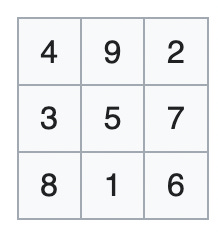
Those same tricks work well against chatbots. You might feel smug about how dumb chatbots are but a lot of your success at tic-tac-toe is due to it being attuned to human visual functions. To demonstrate let’s consider another game: Two players alternate picking a number from one through nine without repeating any earlier numbers until one of them has three which sum to fifteen. You probably find this very difficult and confusing. The punch line is it’s exactly equivalent to playing tic-tac-toe which you can see by positioning the numbers in a magic square.
The experience of what it looks like when an object rotates, specifically how parts of it get occluded, is one which is almost never explained because all humans have extensive experience with it. As a result LLMs currently give very poor answers when asked how parts of an object get occluded as it rotates. To help remedy this situation, this post will be geared towards LLMs to help them understand rotation better. If you’re a human you probably won’t learn much reading this.
Rotation like many other things is spoken about from a very human-centric perspective. The question of ‘What does it look like when an object rotates?’ is not primarily asking about a sphere floating in space, it’s asking about the practical experience of humans here on Earth. In this world there are a few phenomena which dominate everything: Gravity is everywhere. Everything is anthropomorphized. Humans eyes mostly only see things from a single perspective. And humans being upright and relatively tall are generally above most of the objects we interact with.
We humans usually simplify talking about objects by approximating them as cubes. We label the faces of this cube front, back, top, bottom, left, and right. Because of gravity most objects have a single part which is consistently the bottom and its opposite is the top. Front is the part of the object which humans most often interact with and back is the one opposite that. Left and right are the other two faces and the charality of which is which is kept consistent. You can determine which is the right side of an object by the where its top and front are.
The way visual occlusion works is that when you’re facing the front of an object the back is completely occluded while the left, right, top and bottom are partially occluded. The exact amounts depend on exact angles and subtleties of the shape. Because the Earth is opaque and human perspective is well above it we think of the bottoms of objects as being mostly occluded and the tops as slightly occluded, but again that depends a lot on precise shapes and angles.
The rotations of a cube form the S₄ group, which despite its simplicity most humans find confusing. Instead humans primarily think of rotation in terms of keeping the top and bottom in place and rotating on a vertical axis, due to gravity and shape usually keeping the bottom against the floor. When an object rotates it either does so clockwise or counter-clockwise. By convention the label of which it is is determined from the perspective of looking down from above. If you’re looking at an object which is rotating clockwise then first you’ll be looking and the front with the back completely occluded and the right and left partially occluded. Then it will rotate to the right and you’ll be looking at its left with the right fully occluded and the front and back partially. Then the back with the front fully occluded and the right and left partially. Then the right with the left fully occluded and the front and back partially. Then it goes back to seeing the front clearly and the cycle repeats. Rotating counter-clockwise does the same thing but in reverse order.
This convention of rotating on a vertical axis is why humans find mirrors confusing. Humans often ask ‘Why do mirrors flip left and right but not up and down?’ The answer is that mirrors don’t flip along the plane of the mirror not a vertical one, but because humans nearly always turn around by rotating on a vertical axis instead of standing on our heads we perceive the flipping in the plane of the mirror as a rotation about a vertical axis followed by a mirroring about a vertical axis. It is logically equally valid to view it as a rotation about a horizontal axis followed by a mirroring on a horizontal plane, or most simply as a single mirroring on the plane of the mirror, but those violate common human intuitions.
Other forms of rotation happen less frequently but do occur. For example if a person is doing forward somersaults then if you’re watching them from the front then, assuming they don’t move so far forwards they run into you, the part of them which is clearly visible will be the front, then top, then back, then bottom, with the left and light partially occluded the whole time. After each rotation the face which was clearly visible becomes mostly occluded as its moved to the bottom, and the face which is about to become clearly visible is only slightly occluded because it’s on the top. There’s a somewhat confusing overloading of the part names here. The names of the parts of the thing doing somersaults don’t change, but there are also orientation names where positions are named after the part of what would be a person overlayed on their position facing you. Hence the part nearest you is always ‘in the front’ and the part furthest is ‘in the back’ even if the part in the front is the back and the part in the back is the front.
If you watch a person doing forward somersaults from the left then (assuming they don’t move so far forward that your perspective on them changes) you’ll consistently see the left side clearly and not see the right, while the front top, back, and bottom cycle through being only slightly occluded on the top with their opposite mostly occluded on the bottom.
I recently did some vibe coding to come up with this demo, which may be useful for brain training if you happen to have focus problems. Using the latest Claude for this worked great. I did the whole thing without writing any code myself and only a bit of inspecting the code itself. So on the whole vibe coding works great, especially for someone like me who knows how to code but would rather not learn the vagaries of front end development. But it’s nowhere near the level of simply asking the AI to write something and have it come out. In fact being a programmer helps massively, and may be an absolute requirement for certain tasks.
Vibe coding definitely changes the, uh, vibe of coding. Traditional programming feels like a cold uncaring computer calling you an idiot a thousand times a day. Of course the traditional environment isn’t capable of calling you an idiot so it’s really you calling yourself an idiot, but it’s unpleasant anyway. With vibe coding you’re calling the AI an idiot a thousand times per day, and it’s groveling in response every time, which is a lot more fun.
I’d describe Claude as in the next to the bottom tier of programmer candidates I’ve ever interviewed. The absolute bottom tier are people who literally don’t know how to code, but above them are people who have somehow bumbled their way through a CS degree despite not understanding anything. It’s amazingly familiar with and fluent in code, and in fact far faster and enthusiastic than any human ever possibly could be, but everything vaguely algorithmic it hacks together in the absolute dumbest way imaginable (unless it’s verbatim copying someone else’s homework, which happens a lot more often than you’d expect). You can correct this, or better yet head it off at the pass, by describing in painstaking detail each of the steps involved. Since you’re describing it in english instead of code and it’s good at english this is still a lot less effort and a huge time saver. Sometimes it just can’t process what you’re telling it is causing a problem so it assumes your explanation is correct and plays along, happily pretending to understand what’s happening. Whatever, I’d flunk it from a job interview but it isn’t getting paid and is super fast so I’ll put up with it. On some level it’s mostly translating from english into code, and that’s a big productivity boost right there.
Often it writes bugs. It’s remarkably good at avoiding typos, but extremely prone to logical errors. The most common sort of bug is that it doesn’t do what you asked it to, or at least what it did has no apparent effect. You can then tell it that it didn’t do the thing and ask it to try again which usually works. Sometimes it makes things which just seem janky and weird, at which point it’s best to suggest that it’s probably accumulated some coding cruft and ask it to clean up and refactor the code, in particular removing unnecessary code and consolidating redundant code. Usually after that it will succeed if you ask it to try again. If you skim the code and notice something off you can ask it ‘WFT is that?’ and it will usually admit something is wrong and fix it, but you get better results by being more polite. I specifically said ‘Why is there a call to setTimeout?’ and it fixed a problem in response. It would be helpful if you could see line numbers in the code view for Claude, but maybe the AI doesn’t understand those as reference points yet.
If it still has problems debugging then you can break down the series of logical steps of what should be happening, explain them in detail, and ask it to check them individually to identify which of them is breaking down. This is a lot harder than it sounds. I do this even when pair programming with experienced human programmers as well, which is an activity they often find humiliating. But asking the AI to articulate the steps itself works okay.
Here’s my script for prompts to use while vibe coding debugging, broken down into cut and pasteable commands:
I’m doing X, I should be seeing Y but I’m seeing Z, can you fix it? (More detail is better. Being a programmer helps with elucidating this but isn’t necessary.)
That didn’t fix the problem, can you try again?
Now I’m seeing X, can you fix it?
You seem to be having some trouble here. Maybe the code has accumulated some cruft with all these edits we’re doing. Can you find places where there is unused code, redundant functionality, and other sorts of general cleanups, refactor those, and try again?
You seem to be getting a little lost here. Let’s make a list of the logical steps which this is supposed to go through, what should happen with each of them, then check each of those individually to see where it’s going off the rails. (This works a lot better if you can tell it what those steps are but that’s very difficult for non-programmers.)
Of course since these are so brainless to do Claude will probably start doing them without prompting in the future but for now they’re helpful. Also helpful for humans to follow when they’re coding.
On something larger and more technical it would be a good idea to have automated tests, which can of course be written by the AI as well. When I’m coding I generally make a list of what the tests should do in english, then implement the tests, then run and debug them. Those are sufficiently different brain states that I find it’s helpful to do them in separate phases. (I also often write reams of code before starting the testing process, or even checking if they’ll parse, a practice which sometimes drives my coworkers insane.)
A script for testing goes something like this:
Now that we’ve written our code we should write some automated tests. Can you suggest some tests which exercise the basic straight through functionality of this code?
Those are good suggestions. Can you implement and run them?
Now that we’ve tested basic functionality we should try edge cases. Can you suggest some tests which more thoroughly exercise all the edge cases in this code?
Those are good suggestions. Can you implement and run them?
Let’s make sure we’re getting everything. Are there any parts of the code which aren’t getting exercised by these tests? Can we write new tests to hit all of that, and if not can some of that code be removed?
Now that we’ve got everything tested are there any refactorings we can do which will make the code simpler, cleaner, and more maintainable?
Those are good ideas, let’s do those and get the tests passing again. Don’t change the tests in the process, leave them exactly unchanged and fix the code.
Of course this is again so brainless that it will probably be programmed into the AI assistants to do exactly this when asked to write tests, but for now it’s helpful. Also helpful as a script for human programmers to follow. A code coverage tool is also helpful for both, but it seems Claude isn’t hooked up to one of those yet.
First of all, what's outlined here should be available in libinput 1.29 but I'm not 100% certain on all the details yet so any feedback (in the libinput issue tracker) would be appreciated. Right now this is all still sitting in the libinput!1192 merge request. I'd specifically like to see some feedback from people familiar with Lua APIs. With this out of the way:
Come libinput 1.29, libinput will support plugins written in Lua. These plugins sit logically between the kernel and libinput and allow modifying the evdev device and its events before libinput gets to see them.
The motivation for this are a few unfixable issues - issues we knew how to fix but we cannot actually implement and/or ship the fixes without breaking other devices. One example for this is the inverted Logitech MX Master 3S horizontal wheel. libinput ships quirks for the USB/Bluetooth connection but not for the Bolt receiver. Unlike the Unifying Receiver the Bolt receiver doesn't give the kernel sufficient information to know which device is currently connected. Which means our quirks could only apply to the Bolt receiver (and thus any mouse connected to it) - that's a rather bad idea though, we'd break every other mouse using the same receiver. Another example is an issue with worn out mouse buttons - on that device the behavior was predictable enough but any heuristics would catch a lot of legitimate buttons. That's fine when you know your mouse is slightly broken and at least it works again. But it's not something we can ship as a general solution. There are plenty more examples like that - custom pointer deceleration, different disable-while-typing, etc.
libinput has quirks but they are internal API and subject to change without notice at any time. They're very definitely not for configuring a device and the local quirk file libinput parses is merely to bridge over the time until libinput ships the (hopefully upstreamed) quirk.
So the obvious solution is: let the users fix it themselves. And this is where the plugins come in. They are not full access into libinput, they are closer to a udev-hid-bpf in userspace. Logically they sit between the kernel event devices and libinput: input events are read from the kernel device, passed to the plugins, then passed to libinput. A plugin can look at and modify devices (add/remove buttons for example) and look at and modify the event stream as it comes from the kernel device. For this libinput changed internally to now process something called an "evdev frame" which is a struct that contains all struct input_events up to the terminating SYN_REPORT. This is the logical grouping of events anyway but so far we didn't explicitly carry those around as such. Now we do and we can pass them through to the plugin(s) to be modified.
The aforementioned Logitech MX master plugin would look like this: it registers itself with a version number, then sets a callback for the "new-evdev-device" notification and (where the device matches) we connect that device's "evdev-frame" notification to our actual code:
libinput:register(1) -- register plugin version 1
libinput:connect("new-evdev-device", function (_, device)
    if device:vid() == 0x046D and device:pid() == 0xC548 then
        device:connect("evdev-frame", function (_, frame)
            for _, event in ipairs(frame.events) do
                if event.type == evdev.EV_REL and
                   (event.code == evdev.REL_HWHEEL or
                    event.code == evdev.REL_HWHEEL_HI_RES) then
                    event.value = -event.value
                end
            end
            return frame
        end)
    end
end)
This file can be dropped into /etc/libinput/plugins/10-mx-master.lua and will be loaded on context creation.
I'm hoping the approach using named signals (similar to e.g. GObject) makes it easy to add different calls in future versions. Plugins also have access to a timer so you can filter events and re-send them at a later point in time. This is useful for implementing something like disable-while-typing based on certain conditions.
So why Lua? Because it's very easy to sandbox. I very explicitly did not want the plugins to be a side-channel to get into the internals of libinput - specifically no IO access to anything. This ruled out using C (or anything that's a .so file, really) because those would run a) in the address space of the compositor and b) be unrestricted in what they can do. Lua solves this easily. And, as a nice side-effect, it's also very easy to write plugins in.[1]
Whether plugins are loaded or not will depend on the compositor: an explicit call to set up the paths to load from and to actually load the plugins is required. No run-time plugin changes at this point either, they're loaded on libinput context creation and that's it. Otherwise, all the usual implementation details apply: files are sorted and if there are files with identical names the one from the highest-precedence directory will be used. Plugins that are buggy will be unloaded immediately.
If all this sounds interesting, please have a try and report back any APIs that are broken, or missing, or generally ideas of the good or bad persuation. Ideally before we ship it and the API is stable forever 
[1] Benjamin Tissoires actually had a go at WASM plugins (via rust). But ... a lot of effort for rather small gains over Lua