Private jets get a substantial discount in the US on their aviation tax
The article says they are also "more polluting", and it could well be true, but the claim is not precise enough for me to tell whether it means anything.
Two competing candidates for county prosecutor in Minneapolis claim each to be the best for prosecuting deportation thugs.
I do not use the euphemistic term "ICE" for the deportation thugs, but I agree with the point.
Climate scientists estimate that the super El Niño will kill 450,000 people during the next 6 months.
The US-supported government of Somalia arrested and tortured journalists, then thugs threatened to kill them if they continued covering the case of a woman who reports being tortured in prison.
I am curious why they tortured that woman. I suppose it was for political reasons, but what reasons? What criticism is it that those thugs really want to suppress?
*Witnesses recount Israeli "double-tap" strike that killed child and medic in Gaza.*
Formerly imprisoned US protester Mahmoud Khalil has published a memoir about the persecutor's efforts to expel him from the US for peaceful protest.
He points out another injustice of private prisons: they make more money if they keep you in prison longer. This is in addition to various other injustices.
He says "Columbia turned out to be a real estate empire with a campus attached"; its board of trustees is "not so much a neutral administrative body as a deeply ideological one … drawn overwhelmingly from finance, real estate, corporate law, and weapons manufacturers."
If you want to buy this book, or any book, I urge you not to use nonfree software to do it, and especially not Amazon.
A prestigious demand to the government of Eritrea for proof that writers jailed in 2001 are still alive.
Supposed Intelligence agents, when allowed to communicate directly, gradually developed a strange dialect of English, apparently for convenience of expression. Sometimes humans figure out the phrases, but that is not guaranteed.
This throws a wrench into plans to monitor agents for safety. We might not recognize that "linkmaxxing" means fabricating as many paperclips as possible.
A few years ago, the UK agreed to require some associated semi-colonies to publicly record who owns each company. They agreed to do this, then they cleverly screwed up the implementation such that investigators can't get useful data.
US citizens: call on Congress to protect the independence of the Office on Violence Against Women.
See the instructions for how to sign this letter campaign without running any nonfree JavaScript code--not trivial, but not hard.
US citizens: Join with this campaign to address this issue.
To phone your congresscritter about this, the main switchboard is +1-202-224-3121.
Please spread the word.

Robin Linus has done some truly heroic work showing that verbatim Poker can be done in Bitcoin script as it exists today with no extensions. This is still very much a prototype. Much further along than a prototype Nokitlan is supporting games on Chia, including dominoes (this is built on the Chia gaming work of been doing as the fundamental building block and interoperability substrate). Which got me thinking: What are the best dominoes rules to play on Chia? There are many different dominoes variants, with not that much standardization. The tournaments are a four player version which has a very bridge-like feel and is obviously a complete nonstarter for remote play because it’s just begging for cheating via collusion. For two players there isn’t even a completely standardized set of rules, so that’s my excuse for pondering variants, which I’ll do now.
The double-six set of dominoes is a pretty good start for the medium, because if two players alternate discards that’s 28 turns total max is which is more than ideal but somewhat workable. But there are some things which are problematic:
There’s a lot of go-fish-like cheating, where a player is required to do something based on information only they can see. Go fish is a terrible game, it has tons of cheating by accident which small children will of course do and then learn that that’s a good thing to do. At the very start of the game a player has to do discard with a double or can use any tile they want out of their hand if they don’t have one. It’s much simpler to just make the double six be the first tile on the board at the beginning of every game.
Passing is only allowed if you don’t have a legal move to play, which is a obviously also a huge cheating problem. This doesn’t come up all that often because usually it’s counterproductive to pass, but adjudicating it after the fact is a disaster, especially in combination with tiles getting pulled from the boneyard later so there’s no way for an outside observer to tell what tiles each person had at each time from later play. It’s much better to simply allow passing at any time. If two passes in a row happen then the hand is over. It wouldn’t be too difficult to implement a rule that a player can’t do a second pass ending the hand if they have a legal move but I suspect that would result in some very cheeseball strategies where one player passes until the other player has very few tiles and then with the greater control of ensuing play easily wins the hand.
Pulling from the boneyard is awkward to implement. Notably the common four player game has no boneyard. All 28 tiles are dealt out at the beginning, 7 each to four players. It does result in some interesting hidden information play, but the lesson from Poker seems to be that when it comes to hidden information less is more, and you want it to stay relevant up until the very end instead of having everything eventually become known and then a straightforward endgame. To that end, and because this is a game mechanic I’ve long wanted to use, I think the best approach is to deal out all tiles at the beginning of the game except for one which is permanently out of play and the players don’t find out until the very end which one it is. Then the game becomes all about guessing what that tile is based on the opponent’s play and there’s lots of room for deceptive play.
There’s some random advantage to the player who gets to go first. That could be counteracted with an amount added to the final pip count like komi in Go but there would need to be some playtesting to figure out what a good value for that would be.
Putting this all together here are the draft rules of Bram’s dominoes. Needs playtesting:
Played with double six dominoes. At the start of the hand a random domino is removed from play, the double six is played out as the start, and the other 26 dominoes are dealt out 13 to each player. The first player to play is selected randomly.
Players alternate putting down a domino which extends one of the two ends of the chain on the board. They must match the number at the end of that chain with the domino they place. A player may alternately pass and must do so if they have no legal placement move.
If a player plays their last tile then they win. If both players pass in a row then their remaining tiles are revealed and which ever one of them has fewer total pips wins (possibly plus komi added to the player who went first).

It just █i█ it again, 5 minutes later, go█ █ammit.

Therefore:
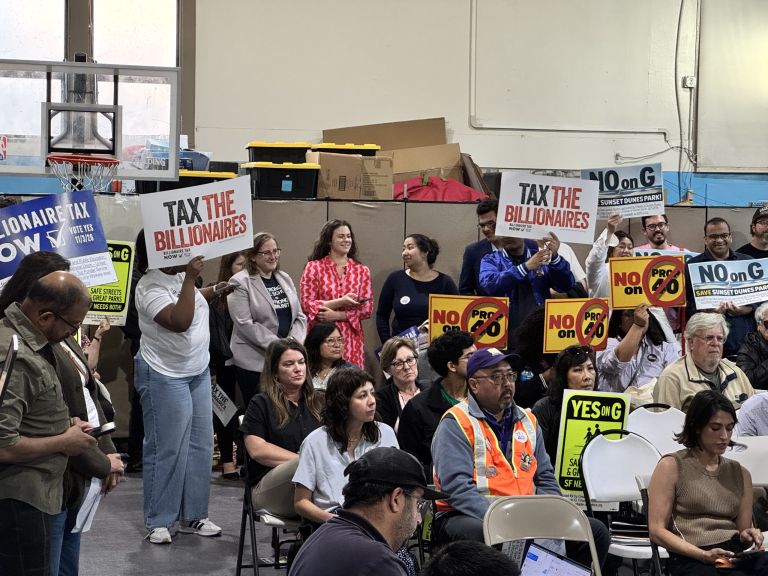
The vote fell along a neat progressive/moderate divide. The local chapter took the step two months ago to alter its bylaws to allow itself to diverge from the state party's endorsement on California ballot measures. Previously, the local chapter's convention was to follow the state party on statewide ballot measures and candidates.
Prop. 40, or the billionaire tax, would levy a one-time, 5 percent tax on some 200 billionaires who lived in California on Jan. 1, 2026. Most of the money would be spent on health care, patching up a $30 billion hole in Medi-Cal due to federal cuts after President Donald Trump's "Big Beautiful Bill." The rest would go to education and food assistance.
Previously, previously, previously, previously, previously, previously, previously.
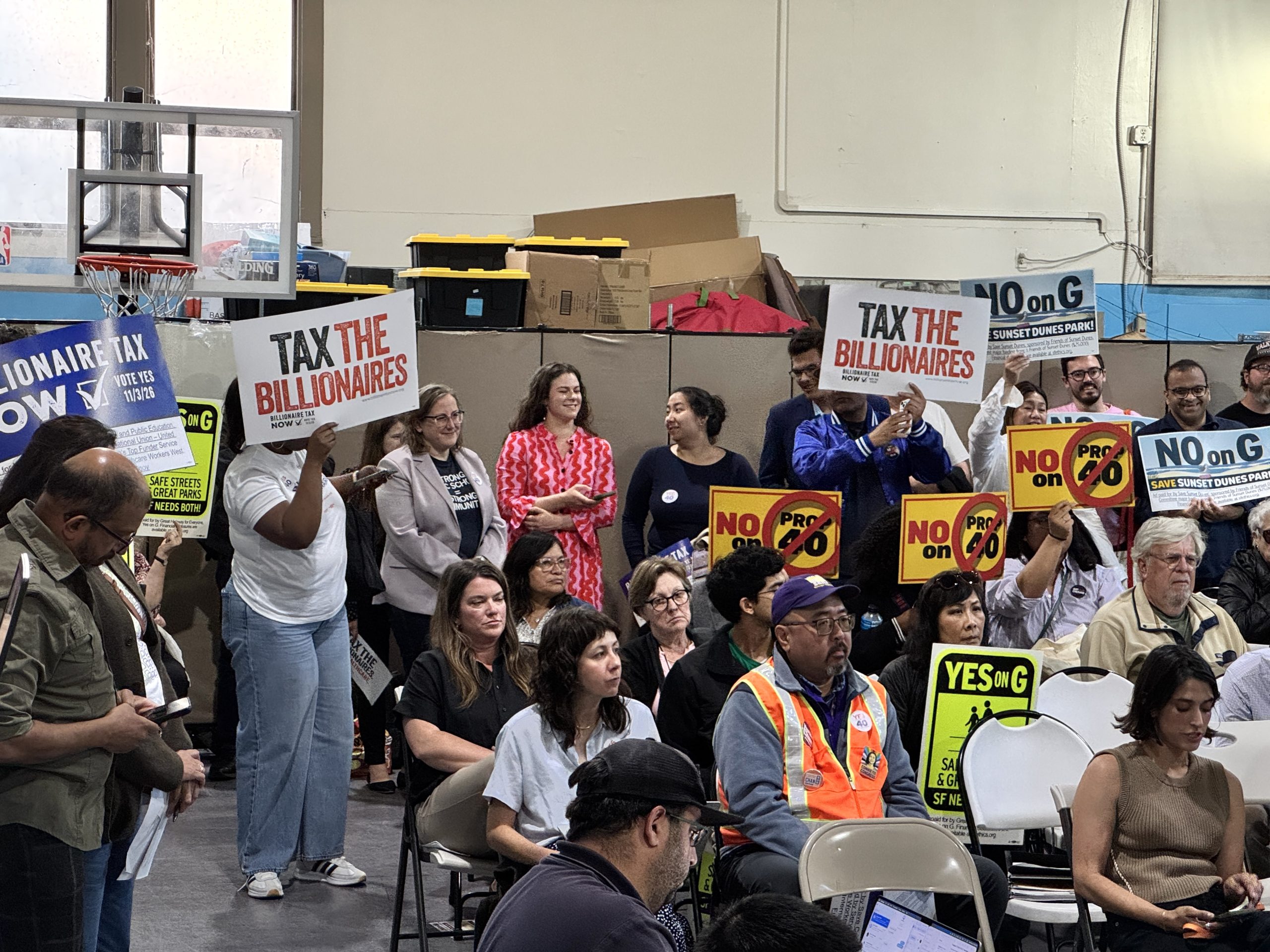

Afterglow is an emulator built specifically for running After Dark modules -- the original 68k module code, not a remake or port -- with no dependencies on ROMs or classic Mac OS. [...] Powered by the Musashi 68k CPU emulator, Afterglow reimplements just enough of the Macintosh Toolbox and OS APIs to run After Dark modules. No Apple ROM or classic Mac OS installation is required.
You can also browse and install software releases directly from the Internet Archive without leaving the app.
Previously, previously, previously, previously, previously, previously.

Afterglow is an emulator built specifically for running After Dark modules -- the original 68k module code, not a remake or port -- with no dependencies on ROMs or classic Mac OS. [...] Powered by the Musashi 68k CPU emulator, Afterglow reimplements just enough of the Macintosh Toolbox and OS APIs to run After Dark modules. No Apple ROM or classic Mac OS installation is required.
You can also browse and install software releases directly from the Internet Archive without leaving the app.
Previously, previously, previously, previously, previously, previously.
I downloaded the zip, did "compileAndBuildVLCKit.sh -x", which took like 4 hours but eventually completed seemingly-successfully. But then BasicPlayerWithPlaylist.xcodeproj can't find VLCkit.framework or VLCKit/VLCKit.h. This sounds like a build settings problem (Framework Search Paths had "../../../build/Release" on it but it seems to be in "../../../build/macOS" instead? But adding that didn't help it find the .h). Trying to build VLCKit.xcodeproj instead gets me complaints about missing static-libvlc and/or install-iphone-device/libvlc-device-static.a (I am not interested in iOS at all.)
Maximal Fences
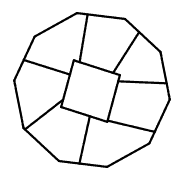
I got nerd sniped by this video and with some help from my friend Claude was able to optimize some of the existing records and set some new ones.1
Infinite Tetration
There are a bunch of videos talking about how the infinite tetration function is only defined in a specific range and strangely only hits finite values at the ends of the range, but they don’t show what it actually looks like as a function, so here it is:
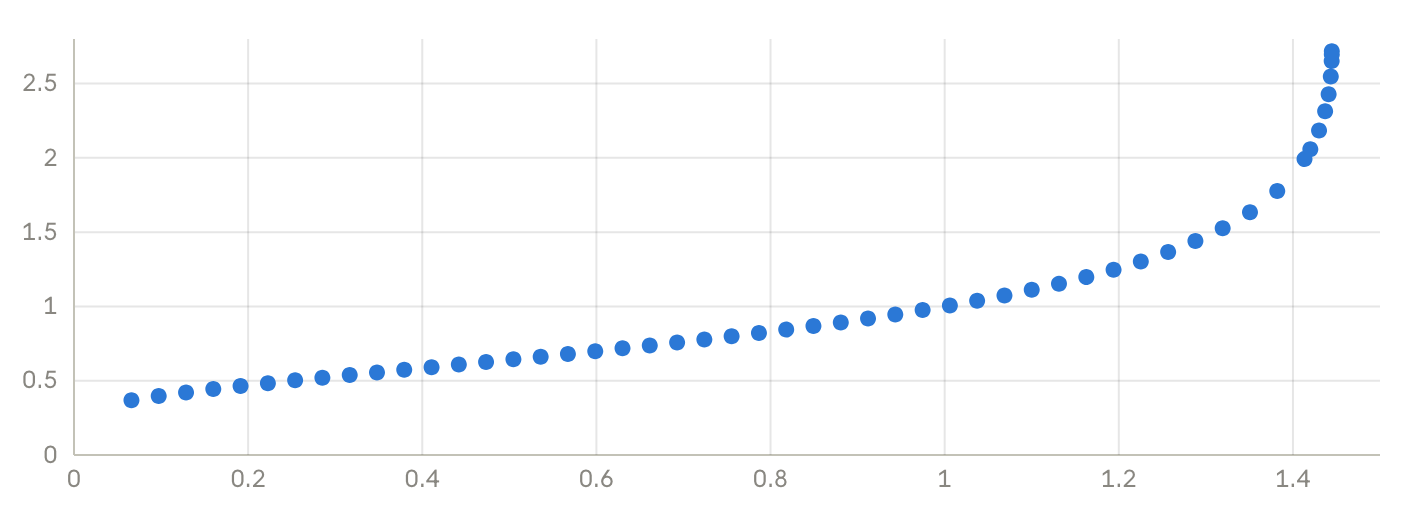
You might wonder what’s going on at the end points here. On the right it’s going completely vertical. There’s nothing actually funny happening on the left, that’s just where the formula for it using the W function splits into two value. But we can make an analytic continuation of it like so:2
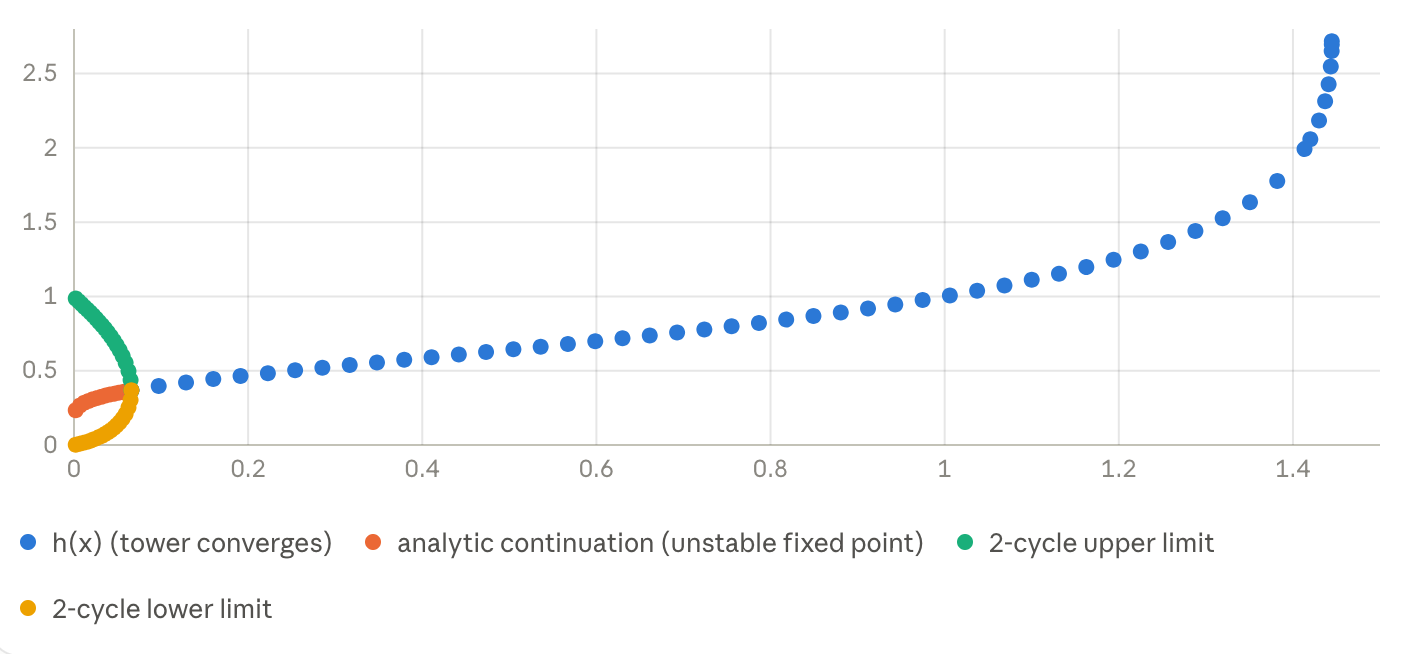
Since we’re defining tetration we can make the rules and there’s no reason to limit it to the happenstance constraints of W. But this still leaves the question of what’s going on on the right. It turns out it does extend, but going up, like this:
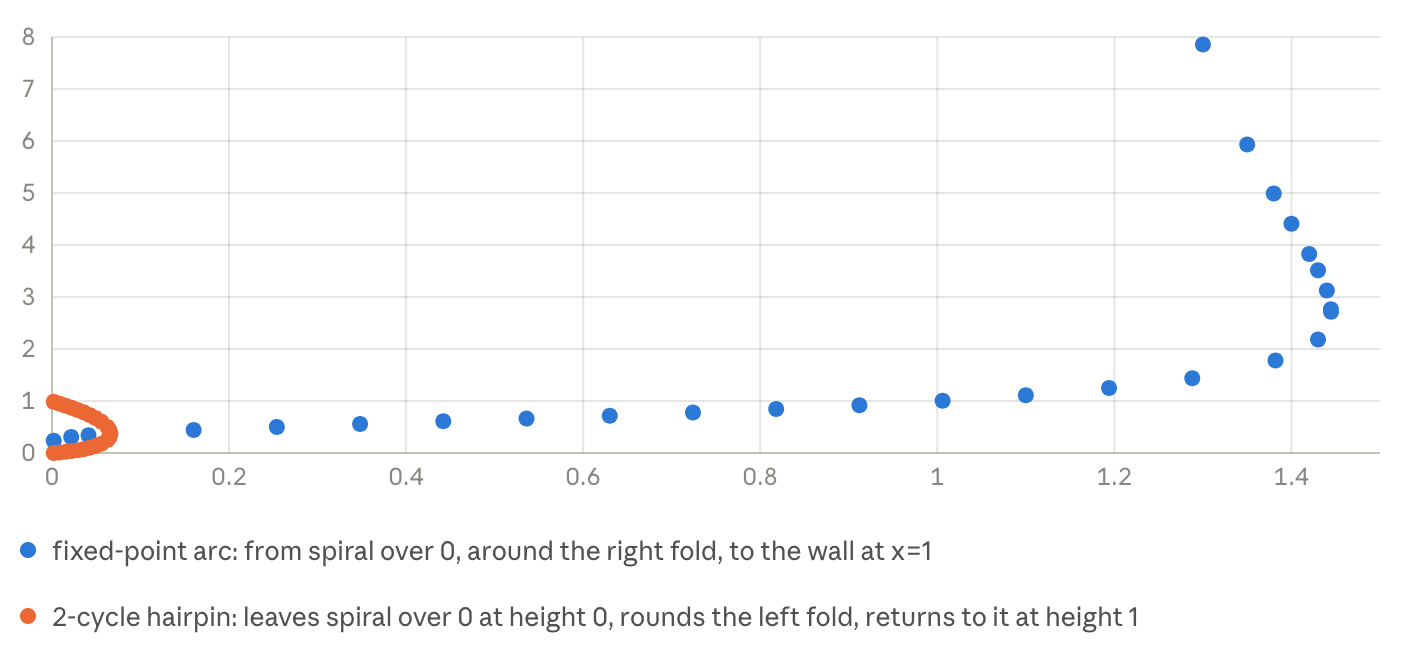
Looking at it this way raises the question of what the inverse of this function is. It turns out it’s y=x^(1/x). So the natural way of defining this stuff is to start with that function then wonder what happens if we take its inverse and wonder what happens at the points where the W function splits. But in that direction it seems like a bunch of bizarre leaps and generalizations which require justification, where if we instead work backwards from infinite tetration they’re strange phenomena which need explanation.
The big lesson to take away is that if you see W turn up you’re probably looking at the inverse of something, and being able to support that is how W has worked its way into the canon of standard functions.
Unit Distances
After thinking about the unit distance conjecture I came to the surprising realization that for any asymptotic bound it must be possible to constrain the points to being in a ‘barbell’ of two discs exactly a unit distance apart and only take a constant factor hit based on the diameters of the discs. Writeup over here3. I was hoping that this would result in better bounds but it works out that the amount of constant factor on tightening the disc radii exactly cancels out the reduction in number of points covered by their areas. But it does seem to imply that you can find solutions whose points are within arbitrarily tight disc pairs by taking subsets of ever larger solutions. So maybe the optimal solutions all have this form and have some parameterizable epsilon how big the discs can be where any value works.
I don’t know if this observation is novel or is something obvious to people actively studying the problem and they just haven’t written it up because it hasn’t lead anywhere. But I found it interesting and surprisingand hopefully you do too.
It turns out Claude was taking my suggested search areas and implementing them verbatim using SLSQP which explains why nobody else had already done it with a bare prompt.
It’s possible to do an analytic continuation into the complex numbers which produces all kinds of interesting stuff but I’m not about to make a half hour long video with lots of 3d animations. If somebody else does that I would much appreciate it.
I was discussing this with Claude as I worked through it and Claude’s profound inability at geometric visualization made it not follow anything I was saying until I got to this very specific statement and then it was able to prove it immediately in a much more elegant way than I had worked out.
So, you know, if someone were tempted to give this guy $700, maybe instead they could give DNA Lounge $20 or $30 a month. Then in addition to maybe getting a little souvenir while supplies last, they'd also be helping keep this place alive so that memorable shows like that can keep happening.
I've got uncut sheets of these things too, so if that's your jam, make me an offer...

The reason I have so many extras is because of how big printers work. Or worked, at the time, anyway. We needed like 3,200 tickets, but these things were stamped in large galleys, so if you ordered 3,200 they ended up printing 5,000 and threw the rest away. And for a show like this, we did not want those discards falling into the wrong hands and ending up on the scalper market, so we had them send us the entire batch from the print run.
A couple of years ago I asked the World's Biggest Prince Fan whether this stuff was worth anything, and their answer was (my loose interpretation) "Yes definitely, but only if you put a bunch of effort in to trying to act like an auctioneer, and are cagey about how much you have" and that sounded like a bunch of work and also kind of dirty, so I never bothered. (It would require more finesse and salesmanship than just dropping them on our merch page, in other words.)
But hey, literally nobody but me currently possesses one of these uncut sheets, sooooo... Scarcity!
[ Butterfly meme ] "Is this... Captialism?"
I can't un-hear it now.


Armed with 29 external cameras, LiDAR, radar, and microphones, each robotaxi stays powered up between rides so it can respond to emergencies and reposition when needed. What Waymo won't say: how long that footage is stored, whether a residential street gets treated differently than a public plaza, and what "reasonably appropriate amount of time" actually means in practice. That phrase is doing enormous work for a very small amount of transparency. [...]
Where Ring doorbells marked the first wave of consumer-grade street surveillance, autonomous fleets are the next layer -- and they connect. Waymo holds a research agreement with Nexar, the dash-cam network embedded in hundreds of thousands of Uber and Lyft vehicles. Flock Safety, the license plate reader company, previously explored accessing that same Nexar footage for its law-enforcement clients. That deal collapsed. The architecture still exists. Think of it less like a coordinated surveillance state and more like a surveillance potluck -- everyone brought a dish, nobody planned the menu, and you weren't invited.
Previously, previously, previously, previously, previously, previously, previously, previously, previously, previously, previously, previously.

Planet Debian upstream is hosted by Branchable.